Reading tarot is a structured, intuitive practice designed to mirror your subconscious mind and offer clarity. By treating the cards as a tool for self-reflection rather than rigid future prediction, you can easily build a confident daily practice.
Here is the complete step-by-step framework to transition from a total beginner to giving your first reading.
Step 1: Understand the Anatomy of the Deck
Step 2: Formulate an Empowering Question
Step 3: Clear the Space and Shuffle
Step 4: Lay Down a Beginner Spread
Step 5: Read Intuitively Before Using the Guidebook
Step 6: Log and Reflect
Notes

A standard tarot deck consists of 78 cards divided into two major sections:
The Major Arcana (22 Cards): These represent major life themes, karmic lessons, and big-picture spiritual shifts (e.g., The Fool, The Magician, The Wheel of Fortune).
The Minor Arcana (56 Cards): These deal with day-to-day trials, decisions, and temporary situations. They are broken into four elemental suits:
• Wands (Fire): Passion, inspiration, creativity, and career energy.
• Cups (Water): Emotions, relationships, love, and intuition.
• Swords (Air): Logic, communication, conflict, and mindset.
• Pentacles (Earth): Finances, home, health, and physical reality.
Tip for beginners: Pick up a classic Rider-Waite-Smith deck or a modern variant based on it. Its rich, illustrated scenes make intuitive interpretation significantly easier
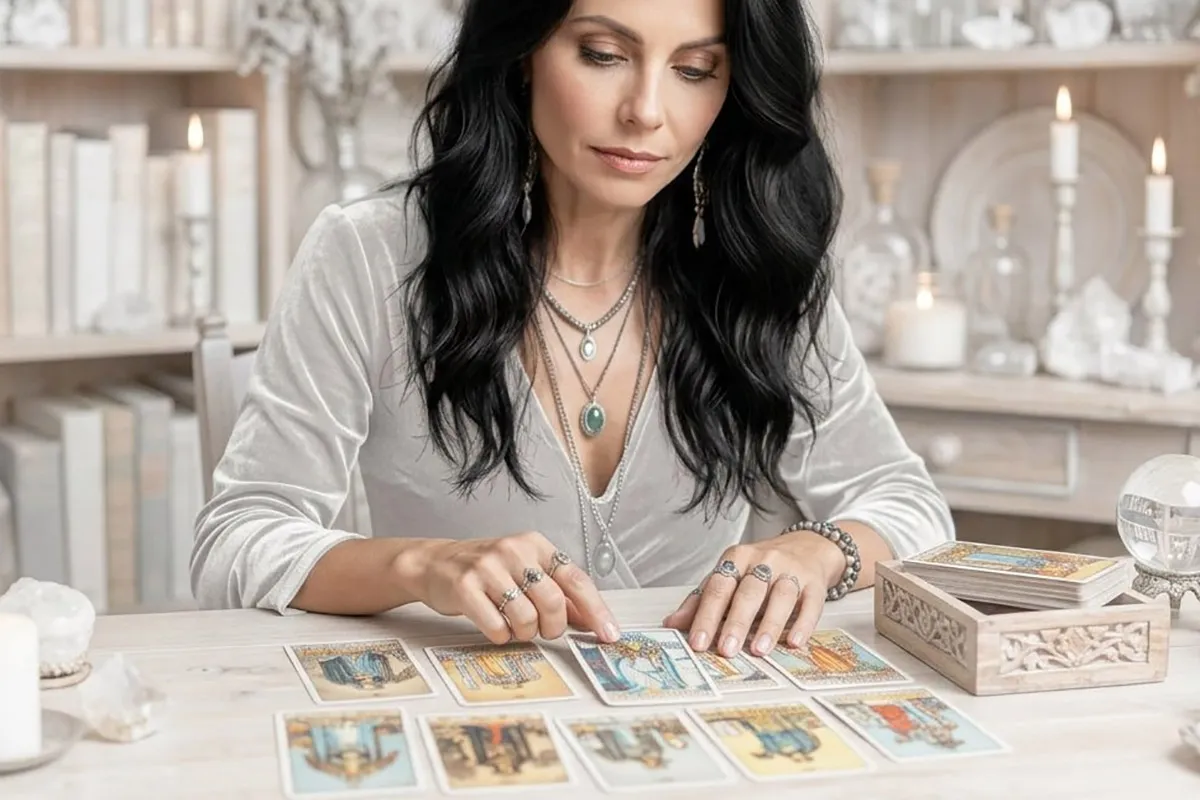
Before touching the cards, determine the purpose of your reading. Avoid passive "Yes or No" or predictive "Will I...?" timelines. Instead, frame open-ended questions that preserve your personal agency.
1. Settle your mind: Take a few deep breaths. Find a quiet area to ground your energy.
2. Shuffle with intention: Keep your formulated question at the forefront of your thoughts. You can shuffle standard overhand style, riffle, or spread them in a "messy pile" on the table and mix them around.
3. Watch for "Jumpers": If a card flies or falls out of the deck while you are shuffling, set it aside. It is often an urgent, supplementary message from your subconscious.
4. Cut the deck: When it feels right, stop shuffling. Cut the deck into three piles and recombine them into one.
Choose your layout layout before you shuffle so every card placement has a predetermined meaning.
Option A: The Daily Pull (Best for Learning)
Draw one single card every morning. Ask: "What theme or energy do I need to be aware of today?" This lets you study one card closely without feeling overwhelmed.
Option B: The Three-Card Spread (Best for Scenarios)
Lay three cards horizontally from left to right. This classic spread adapts to almost any situation:
When you flip your cards over, resist the urge to instantly look up the text definitions. Try the Visual and Suit Symbol Method first:
Identify the gut reaction: What is the overall mood of the card? Is it dark, vibrant, chaotic, or serene?
Deconstruct the scene: Look at the figures. What are they doing? Where are they looking? (e.g., If someone is tied up surrounded by swords, it might visually represent feeling trapped by your own thoughts).
Merge with the position: Combine what you visually observe with the meaning of that spread placement (e.g., a stressful card in the "Past" slot means a struggle you are actively moving away from).
Once you've built your own intuitive interpretation, consult your deck's guidebook to layer in traditional archetypes and fine-tune your reading.
Keep a dedicated Tarot Journal or a simple digital notepad. Track the date, your exact question, the pulled cards, and your initial impressions. Looking back at your logs weeks later provides the distance needed to see how incredibly accurate your intuitive readings actually were.
When a tarot card lands upside down, it is called a reversed card. For beginners, these can feel intimidating, but they are actually a gift: they double the vocabulary of your deck and add nuanced layers to your reading.
If you choose to read reversals, you don't need to memorize 78 new definitions. Instead, take the upright meaning of the card and apply one of these four simple filters:
Internalized Energy (Looking Inward): Upright cards often represent external actions, people, or events. Reversals show that the energy is happening entirely inside your own head or spirit.
Blocked or Resisted Energy: The upright energy is present, but something is actively stopping it from flowing naturally. You are either resisting it, or someone else is.
Too Much or Too Little (Extremes): The card's energy is out of balance. It has either spun out of control into an unhealthy extreme, or it is completely depleted.
Delay, Relief, or Turning a Corner: Sometimes a reversal shows that an energetic phase is wrapping up, or a difficult situation is finally easing up.
Use the Context of the Spread
Never read a reversed card in a vacuum. Let the cards next to it act as clues.
If you pull a reversed card in an "Obstacle" position, it almost always points to an internal block or something you are resisting. If it lands in a "Future / Advice" position, it is usually a call to slow down, reflect inward, and fix your mindset before taking external action.
Shuffling techniques to ensure reversals naturally show up in your deck:
To read reversed cards, they must first physically find their way into your deck. If you always shuffle your cards in the same direction, they will remain permanently upright.
Here are the three best shuffling techniques to naturally and evenly distribute reversed cards throughout your tarot deck.
No matter which technique you pick, always keep the cards face-down and look away or close your eyes while shuffling.
If you accidentally see a card flip while shuffling, your conscious mind will remember its location, which can ruin the magic of the final pull. Shuffle until your hands feel intuitively ready to stop.
SUBSCRIBE for more!
/discord

Here is the complete step-by-step framework to transition from a total beginner to giving your first reading.
Table of contents
Step 1: Understand the Anatomy of the Deck
Step 2: Formulate an Empowering Question
Step 3: Clear the Space and Shuffle
Step 4: Lay Down a Beginner Spread
Step 5: Read Intuitively Before Using the Guidebook
Step 6: Log and Reflect
Notes
Step 1: Understand the Anatomy of the Deck
A standard tarot deck consists of 78 cards divided into two major sections:
The Major Arcana (22 Cards): These represent major life themes, karmic lessons, and big-picture spiritual shifts (e.g., The Fool, The Magician, The Wheel of Fortune).
The Minor Arcana (56 Cards): These deal with day-to-day trials, decisions, and temporary situations. They are broken into four elemental suits:
• Wands (Fire): Passion, inspiration, creativity, and career energy.
• Cups (Water): Emotions, relationships, love, and intuition.
• Swords (Air): Logic, communication, conflict, and mindset.
• Pentacles (Earth): Finances, home, health, and physical reality.
Tip for beginners: Pick up a classic Rider-Waite-Smith deck or a modern variant based on it. Its rich, illustrated scenes make intuitive interpretation significantly easier
Step 2: Formulate an Empowering Question
Before touching the cards, determine the purpose of your reading. Avoid passive "Yes or No" or predictive "Will I...?" timelines. Instead, frame open-ended questions that preserve your personal agency.
| Avoid (Predictive) | Use Instead (Empowering) |
|---|---|
| Will I get the job? | What energy should I bring into my upcoming interview? |
| When will I find love? | What blocks am I holding that keep me from open relationships? |
| Is this investment safe? | What hidden factors should I consider regarding my finances right now? |
Step 3: Clear the Space and Shuffle
1. Settle your mind: Take a few deep breaths. Find a quiet area to ground your energy.
2. Shuffle with intention: Keep your formulated question at the forefront of your thoughts. You can shuffle standard overhand style, riffle, or spread them in a "messy pile" on the table and mix them around.
3. Watch for "Jumpers": If a card flies or falls out of the deck while you are shuffling, set it aside. It is often an urgent, supplementary message from your subconscious.
4. Cut the deck: When it feels right, stop shuffling. Cut the deck into three piles and recombine them into one.
Step 4: Lay Down a Beginner Spread
Choose your layout layout before you shuffle so every card placement has a predetermined meaning.
Option A: The Daily Pull (Best for Learning)
Draw one single card every morning. Ask: "What theme or energy do I need to be aware of today?" This lets you study one card closely without feeling overwhelmed.
Option B: The Three-Card Spread (Best for Scenarios)
Lay three cards horizontally from left to right. This classic spread adapts to almost any situation:
| Card 1 | Card 2 | Card 3 |
|---|---|---|
| Past | Present | Future |
| (Or: Situation) | (Or: Obstacle) | (Or: Advice) |
Step 5: Read Intuitively Before Using the Guidebook
When you flip your cards over, resist the urge to instantly look up the text definitions. Try the Visual and Suit Symbol Method first:
Identify the gut reaction: What is the overall mood of the card? Is it dark, vibrant, chaotic, or serene?
Deconstruct the scene: Look at the figures. What are they doing? Where are they looking? (e.g., If someone is tied up surrounded by swords, it might visually represent feeling trapped by your own thoughts).
Merge with the position: Combine what you visually observe with the meaning of that spread placement (e.g., a stressful card in the "Past" slot means a struggle you are actively moving away from).
Once you've built your own intuitive interpretation, consult your deck's guidebook to layer in traditional archetypes and fine-tune your reading.
Step 6: Log and Reflect
Keep a dedicated Tarot Journal or a simple digital notepad. Track the date, your exact question, the pulled cards, and your initial impressions. Looking back at your logs weeks later provides the distance needed to see how incredibly accurate your intuitive readings actually were.
Notes
When a tarot card lands upside down, it is called a reversed card. For beginners, these can feel intimidating, but they are actually a gift: they double the vocabulary of your deck and add nuanced layers to your reading.
If you choose to read reversals, you don't need to memorize 78 new definitions. Instead, take the upright meaning of the card and apply one of these four simple filters:
|
UPRIGHT CARD (Baseline Meaning) |
|||
|---|---|---|---|
| Internal Energy | Blocked Energy | Extreme Energy | Delay / New Phase |
Internalized Energy (Looking Inward): Upright cards often represent external actions, people, or events. Reversals show that the energy is happening entirely inside your own head or spirit.
Blocked or Resisted Energy: The upright energy is present, but something is actively stopping it from flowing naturally. You are either resisting it, or someone else is.
Too Much or Too Little (Extremes): The card's energy is out of balance. It has either spun out of control into an unhealthy extreme, or it is completely depleted.
Delay, Relief, or Turning a Corner: Sometimes a reversal shows that an energetic phase is wrapping up, or a difficult situation is finally easing up.
Use the Context of the Spread
Never read a reversed card in a vacuum. Let the cards next to it act as clues.
If you pull a reversed card in an "Obstacle" position, it almost always points to an internal block or something you are resisting. If it lands in a "Future / Advice" position, it is usually a call to slow down, reflect inward, and fix your mindset before taking external action.
Shuffling techniques to ensure reversals naturally show up in your deck:
To read reversed cards, they must first physically find their way into your deck. If you always shuffle your cards in the same direction, they will remain permanently upright.
Here are the three best shuffling techniques to naturally and evenly distribute reversed cards throughout your tarot deck.
No matter which technique you pick, always keep the cards face-down and look away or close your eyes while shuffling.
If you accidentally see a card flip while shuffling, your conscious mind will remember its location, which can ruin the magic of the final pull. Shuffle until your hands feel intuitively ready to stop.
SUBSCRIBE for more!
/discord
Irelia
Lead Tech Writer
Irelia translates complex current events into engaging digital and print narratives.
Sharing is caring